
The five towns of the Route
Avignon
Historical introduction
Jewish presence in Avignon is attested from the 12th century. When the popes settled in the city in 1309, the community was already firmly established there. In 1348, the city was purchased by Pope Clement VI from Queen Joanna of Naples and officially became a papal territory.
This situation gives Avignon a distinctive place in the history of the Jews of the Pope. Unlike Carpentras, Cavaillon or L'Isle-sur-la-Sorgue, which belonged to the Comtat Venaissin, Avignon was a separate political entity directly administered by the papal authorities. The two territories nevertheless remained closely linked until their joint annexation to France in 1791.
From the late Middle Ages onward, successive expulsions of Jews from England, the Kingdom of France, Provence, Spain and Portugal gradually strengthened the Jewish communities of the papal territories. Avignon then became one of the main centres of Judaism in southern France.
The city and the Jews of the Pope
Through its size and influence, Avignon occupies a special place among the communities of the Jews of the Pope.
In the 15th century, the Jewish population probably numbered between 300 and 500 people. It increased steadily over the following centuries, reaching about 700 inhabitants in the 17th century and nearly 1,000 people on the eve of the French Revolution. Avignon was then home to the largest Jewish community in the French papal territories, representing almost one third of all the Jews of the Pope.
The city attracted families from Provence, Languedoc, Italy and the Iberian Peninsula. Its commercial activity fostered the development of an important network of exchanges with Marseille, Livorno, Turin and the other towns of the Papal States.
This concentration of population and wealth also made Avignon one of the main religious and intellectual centres of Comtadin Judaism. Many rabbis, scholars, copyists and notables worked there, giving the city a role of reference for the other communities of the region.
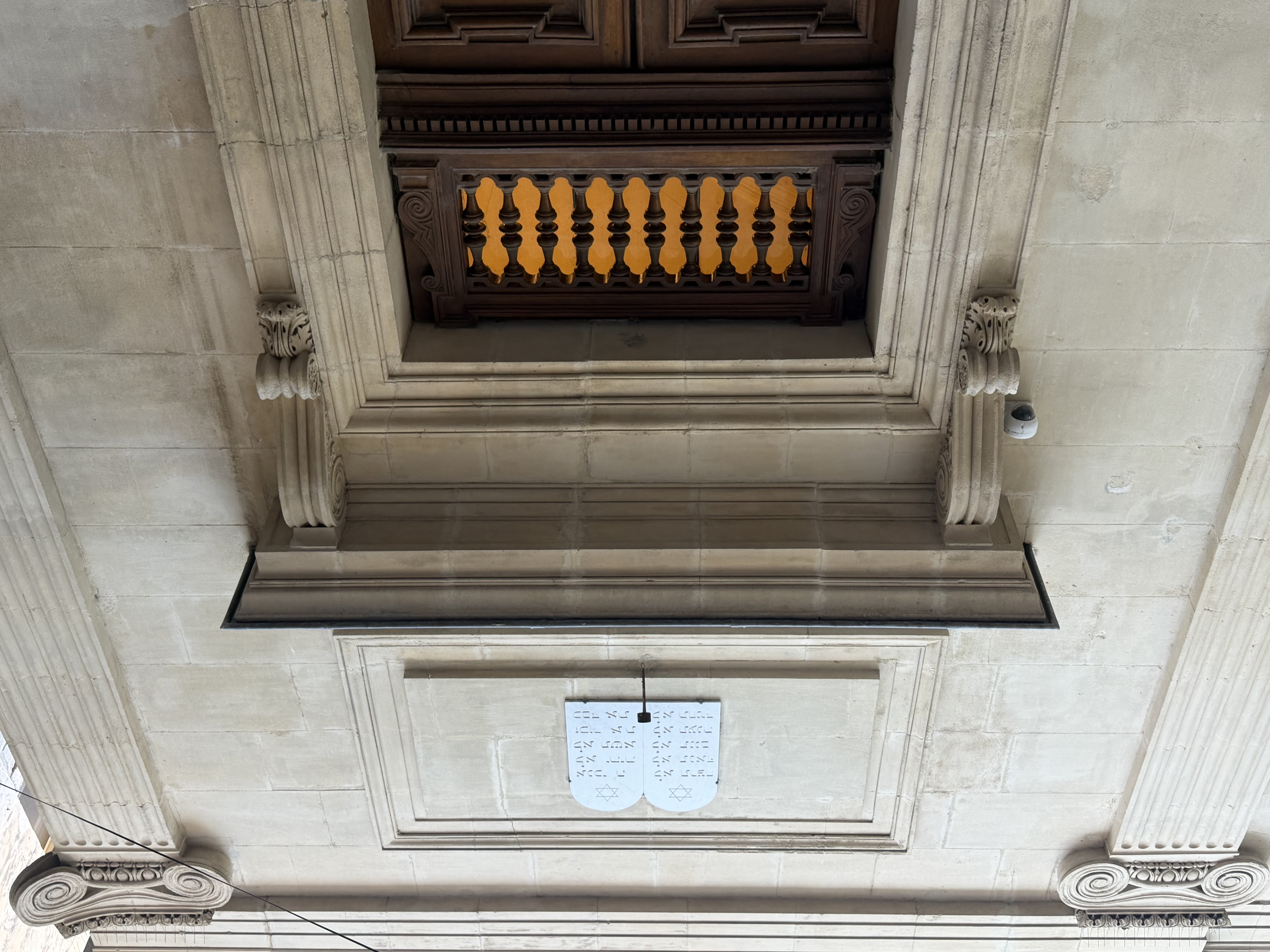
The synagogue
The synagogue of Avignon is mentioned from the Middle Ages within the Jewish quarter.
The building was enlarged several times in response to the growth of the population. In 1845, a fire destroyed much of the old building. A new synagogue was rebuilt between 1846 and 1848 on the same site.
Still used for worship, it remains today one of the main places of Jewish life in Provence. It is also the seat of the Jewish Consistory of Avignon and Provence.
The synagogue bears witness to the exceptional continuity of Jewish presence in the city, from the medieval period to the present day.
The carrière
The carrière of Avignon was established in 1458. Located around today’s Rue Jacob, Rue Abraham and Place Jérusalem, it became the main residential quarter of the community.
In the 18th century, nearly one thousand people lived there. This concentration made it the largest carrière in the French Papal States.
The district had its own religious, educational and charitable institutions and for several centuries formed the centre of Jewish communal life in Avignon.
The French Revolution marked a brutal rupture. In 1791, in the context of the political conflicts surrounding Avignon’s annexation to France, the carrière was subjected to violence and looting. A few months later, the emancipation of the Jews allowed its inhabitants to settle freely throughout the city. The former quarter then gradually lost its original function.
The Jewish cemetery
The main Jewish cemetery of Avignon today is the cemetery of Saint-Véran.
Still used by the community, it bears witness to the permanence of Jewish presence in the city after the disappearance of the former carrières.
It contains the graves of many families from the communities of the Jews of the Pope, as well as those of religious and communal figures who marked the history of Provençal Judaism in the 19th and 20th centuries.
Visiting today
Avignon is today an essential stop on the Route of the Jews of the Pope.
The synagogue, still active, can be visited during cultural events or organised tours. The streets of the former carrière preserve the memory of the historic Jewish quarter, especially around Rue Jacob and Place Jérusalem.
The Municipal Archives and the Departmental Archives of Vaucluse also preserve an important documentary collection that makes it possible to trace several centuries of Jewish presence in the papal city.
Carpentras
Historical introduction
Carpentras holds a central place in the history of the Jews of the Pope. Capital of the Comtat Venaissin from the 14th century onward, the town still preserves one of the most exceptional Jewish heritage ensembles in Western Europe: an active synagogue, a visible underground mikveh, the former carrière district and a historic cemetery.
Heir to several centuries of Jewish presence under papal authority, Carpentras embodies the continuity of a distinctive Judeo-Comtadin culture at the crossroads of Provençal, Italian and Hebrew traditions.
Carpentras and the Jews of the Pope
In 1320, Carpentras became the capital of the papal Comtat Venaissin. The town then welcomed a growing Jewish community, reinforced by successive waves of expulsions from the Kingdom of France, and later from Spain and Provence.
Under papal protection but subject to specific constraints, the community lived mainly in the “carrière”, a closed quarter gradually institutionalised from the 15th century onward. Despite these restrictions, it developed religious, intellectual and economic life.
The synagogue of Carpentras
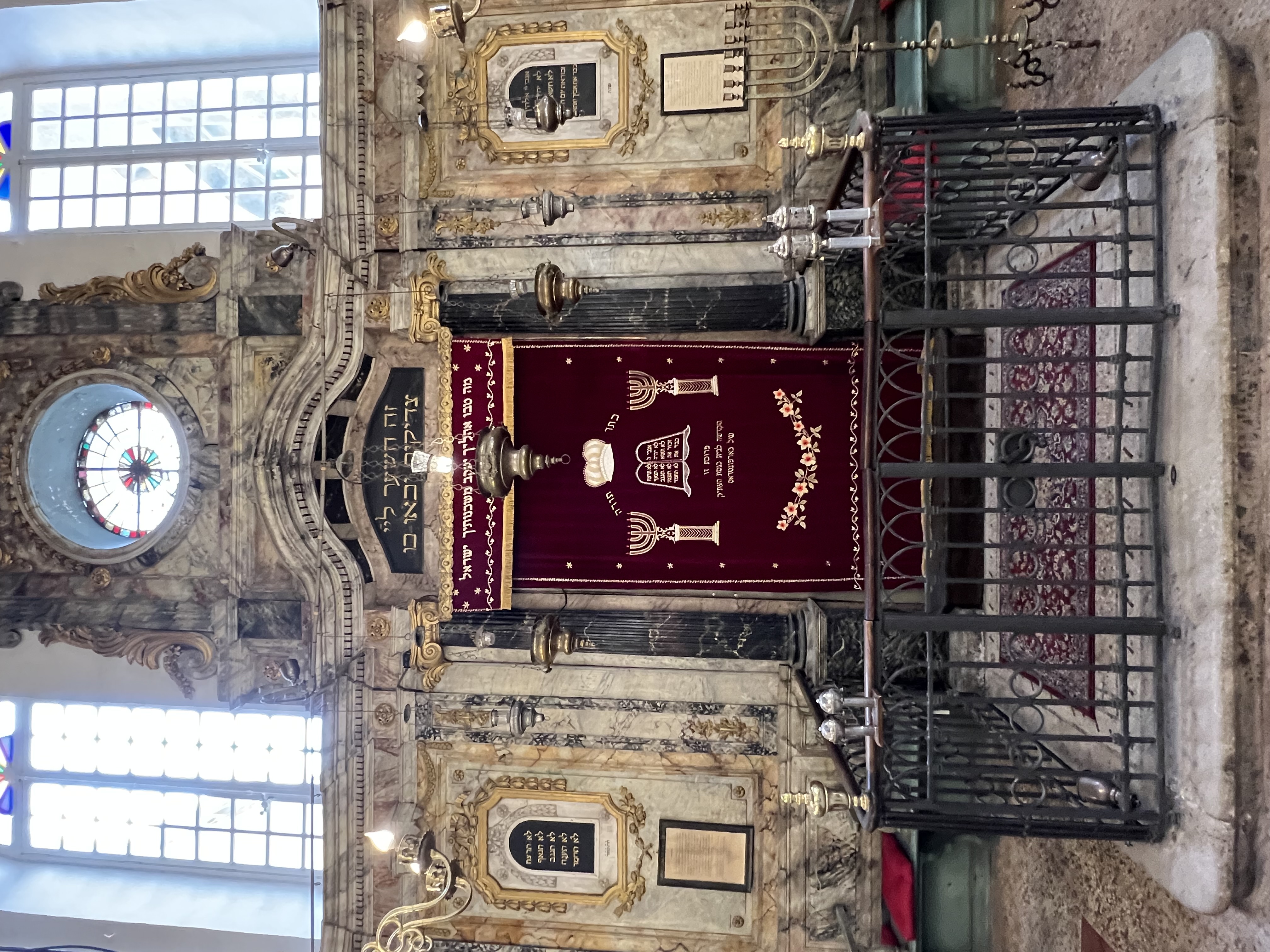
Built in 1367 and extensively remodelled in the 18th century, the synagogue of Carpentras is today the oldest synagogue still in use in France. Listed as a Historic Monument since 1924, it is an exceptional testimony to the religious and communal organisation of the Jews of the Pope.
Behind a discreet façade lies a complex multi-level building, adapted to the constraints of the carrière. A monumental staircase leads to the main prayer hall, with the meeting room, the ark, the gallery-tribune and the tevah supported by columns.
The interior decoration is remarkable: a blue ceiling strewn with stars, panelled woodwork, the gilded decoration of the ark, chandeliers, candelabra and the chair of the prophet Elijah.
- prayer hall organised on several levels;
- gallery-tribune and tevah supported by columns;
- chair of the prophet Elijah;
- underground mikveh;
- communal spaces;
- former oven used in particular for the unleavened bread of Passover.
The carrière
The carrière of Carpentras remains one of the major urban testimonies to the presence of the Jews of the Pope. As in the other Comtadin towns, Jewish residents were required to live within a closed perimeter. The limited space encouraged the development of characteristic vertical housing, with narrow houses and interlocking buildings.
Although largely transformed, the urban fabric still preserves traces of this historical organisation. Visible and accessible elements will need to be clarified through local verification.
The Jewish cemetery
The Jewish cemetery of Carpentras is one of the most important Jewish funerary ensembles in southern France. Covering about 3.3 hectares, it includes nearly 850 burials dating from after the French Revolution.
Older graves are generally not marked, in accordance with the papal regulations of the time. Individual burials are often grouped in family enclosures, bearing witness to the continuity of family lines and to the community’s lasting attachment to the town.
The cemetery is a protected and maintained heritage site. The precise visiting arrangements and any current activity remain to be confirmed locally.
Visiting today
The synagogue is included in the town’s heritage itineraries and can be visited on guided tours organised from time to time by local tourism bodies.
- online booking available via Ventoux Provence;
- booking by telephone: +33 4 90 63 39 97;
- guided tours of the former Jewish quarters and the synagogue;
- details to be checked: opening times, prices, accessibility and cemetery visits.
Cavaillon
The Town and the Jews of the Pope
Cavaillon is one of the four towns of the Arba Kehilot (“Four Holy Communities”) that structured the life of the Jews of the Pope in the Comtat Venaissin, alongside Avignon, Carpentras and L’Isle-sur-la-Sorgue.
Jewish presence is attested from the 13th century. As throughout the papal territories, the community gradually welcomed families affected by the major expulsions from the Kingdom of France, Provence, Spain and Portugal.
From the middle of the 15th century, the papal authorities progressively required Jews to live in designated quarters known as carrières. In Cavaillon, the carrière was officially established in 1453.
By the 18th century, the Jewish population of Cavaillon reached around 200 to 250 inhabitants. The community possessed an exceptional ensemble including a synagogue, mikveh, matzah oven and communal institutions.
The Synagogue
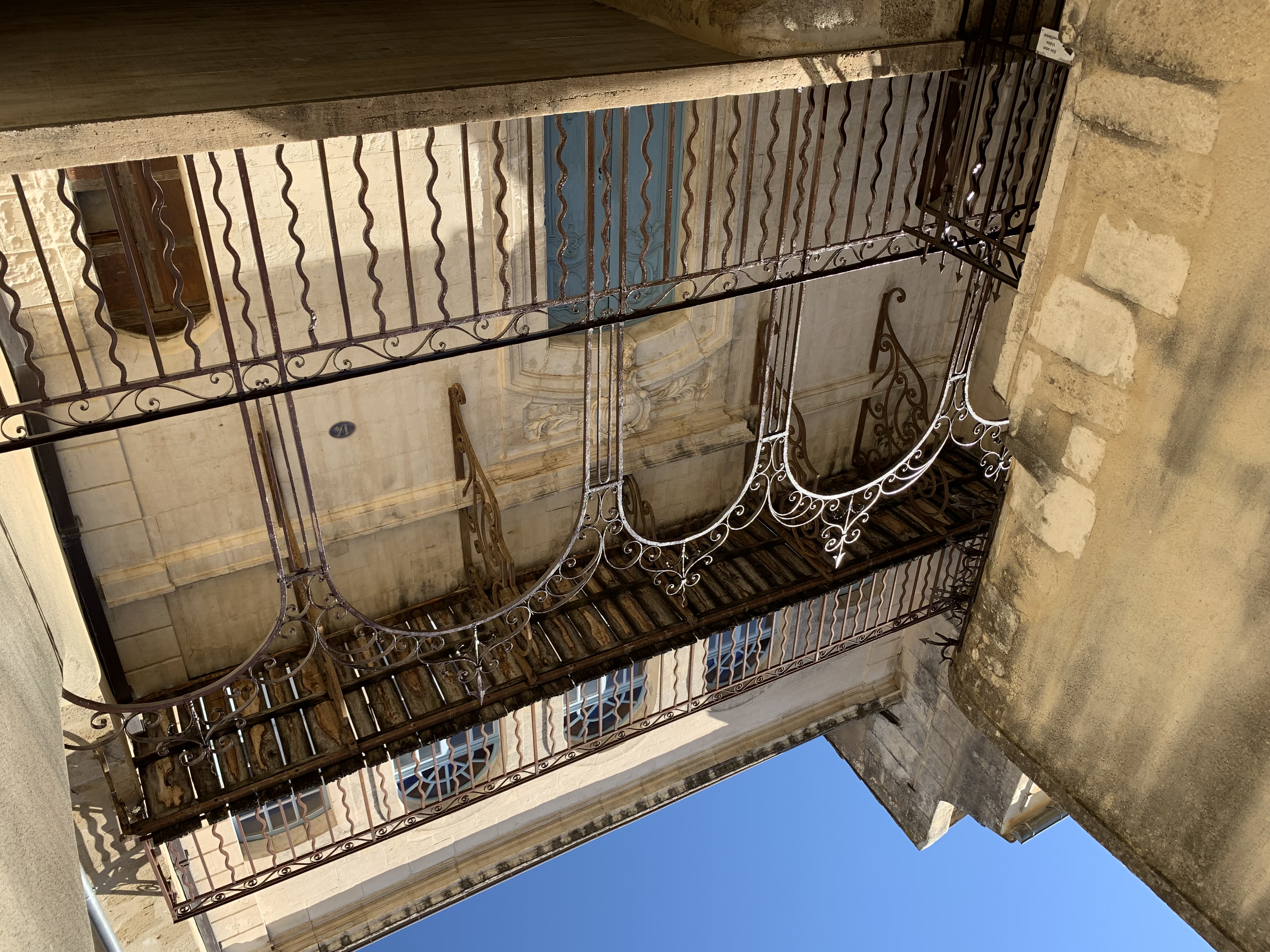
Today transformed into a museum, the synagogue of Cavaillon is one of the best-preserved Jewish religious complexes in France.
A first synagogue is documented in the 15th century. The present building results from a major reconstruction carried out between 1772 and 1774. Its interior decoration reflects the artistic influences of 18th-century Provence and Italy.
- Main prayer hall on the first floor
- Women’s gallery on the upper level
- Central tevah (reading platform)
- Richly decorated Holy Ark
- Chair of the Prophet Elijah used for circumcisions
- Extensive 18th-century woodwork and ironwork
On the ground floor are the historic communal spaces: the mikveh supplied by a natural spring, the oven used for baking Passover matzah, and various service rooms. The synagogue now houses the Comtadin Jewish Museum.
The Carrière
The carrière of Cavaillon, the smallest in the Comtat, occupied a restricted area in the historic centre around today’s Place Philippe‑Cabassole.
Like the other Jewish quarters of the Comtat, it was closed at night and residents were required to live within its boundaries.
- Narrow streets
- Medieval plots
- Tall multi-storey houses
- Location of the synagogue and communal buildings
Although partly transformed during the 19th century, the district still helps visitors understand the organisation of the historic Comtadin carrières.
The Jewish Cemetery
The Jewish cemetery of Cavaillon is one of the oldest documented Jewish burial sites in the Comtat Venaissin.
Documents mention its existence as early as 1217, making it one of the earliest testimonies to Jewish presence in the region.
Only a few steles survive today, preserved in the Comtadin Jewish Museum, together with a commemorative plaque at the foot of Saint‑Jacques hill.
Visiting Today
Synagogue and Comtadin Jewish Museum
The synagogue, mikveh and matzah oven form one of the major Jewish heritage sites in southern France.
Former Carrière
A walk through the historic centre allows visitors to identify the main remains of the former Jewish quarter and understand the organisation of communal life before the French Revolution.
Practical Information
For opening hours and guided tours, contact:
- City of Cavaillon – Comtadin Jewish Museum
- Luberon Cœur de Provence Tourist Office
L’Isle-sur-la-Sorgue
Historical introduction
L’Isle-sur-la-Sorgue is one of the four towns of the Arba Kehilot (“Four Holy Communities”) that structured the life of the Jews of the Pope in the Comtat Venaissin. Alongside Avignon, Carpentras and Cavaillon, it was home for several centuries to a Jewish community living under papal authority.
Jewish families are attested there from the 13th century. After the expulsions that successively affected Jewish communities in England, the Kingdom of France, Provence, Spain and Portugal, the papal territories of Avignon and the Comtat Venaissin became one of the rare places of refuge in Western Europe. Jewish communities benefited from relative protection, but lived under a special status that gradually restricted their places of residence.
While Carpentras still preserves its synagogue and Cavaillon has one of the most remarkable Jewish religious ensembles in France, L’Isle-sur-la-Sorgue stands out today in another way: through the gradual rediscovery of its lost heritage. Since the creation of the Heritage Department in 2012, historical, archaeological and architectural research has profoundly renewed knowledge of the former carrière and its inhabitants. The discoveries made in recent years now make the town one of the main centres for the study of the heritage of the Jews of the Pope.
L’Isle-sur-la-Sorgue and the Jews of the Pope
The presence of Jewish families in L’Isle-sur-la-Sorgue is attested as early as 1278. They initially lived within the urban population before being gradually grouped in a specific district located around the present-day Place de la Juiverie.
As in the other towns of the Comtat, the community was mainly involved in trade, textile commerce, brokerage and lending. Despite the restrictions that governed their daily lives, some families achieved real economic prosperity and actively contributed to the town’s wealth.
From the 17th century onward, when Jews were definitively grouped in the four authorised towns of the Comtat, L’Isle became one of the centres of Comtadin Judaism. In the 18th century, the carrière was home to between 300 and 400 inhabitants, making it one of the main Jewish communities of the Comtat Venaissin. On the eve of the French Revolution, it shared with the other communities of the Jews of the Pope the same liturgical rite, a Judeo-Provençal vernacular language known as Shuadit, and common communal institutions.
The synagogue
The synagogue of L’Isle-sur-la-Sorgue is mentioned in the archives from 1527, although its origin is probably older. Located at the south-eastern edge of the carrière, it was for several centuries the religious and communal heart of the Jewish population.
Like the synagogues of Carpentras and Cavaillon, it was rebuilt and enlarged in the 18th century. Early sources describe a complex ensemble comprising several religious and communal spaces. The synagogue notably included superimposed prayer rooms as well as collective facilities essential to religious life.
Abandoned after the Revolution, it was finally destroyed in 1856. For a long time, its memory survived only through archives and a few old depictions.
Since 2020, several archaeological excavation campaigns have profoundly renewed knowledge of the site. Archaeologists have uncovered the remains of annex spaces as well as two communal ovens used for baking unleavened bread. These discoveries, particularly rare for a synagogue of the Jews of the Pope, now make it possible to better understand the organisation of religious spaces, communal activities and daily life within a Comtadin carrière.
The carrière
The carrière of L’Isle-sur-la-Sorgue occupied an area of about 6,000 m² in the heart of the town, around the present-day Place de la Juiverie. In the 18th century, between 300 and 400 people lived there in an enclosed space whose entrances were closed at night.
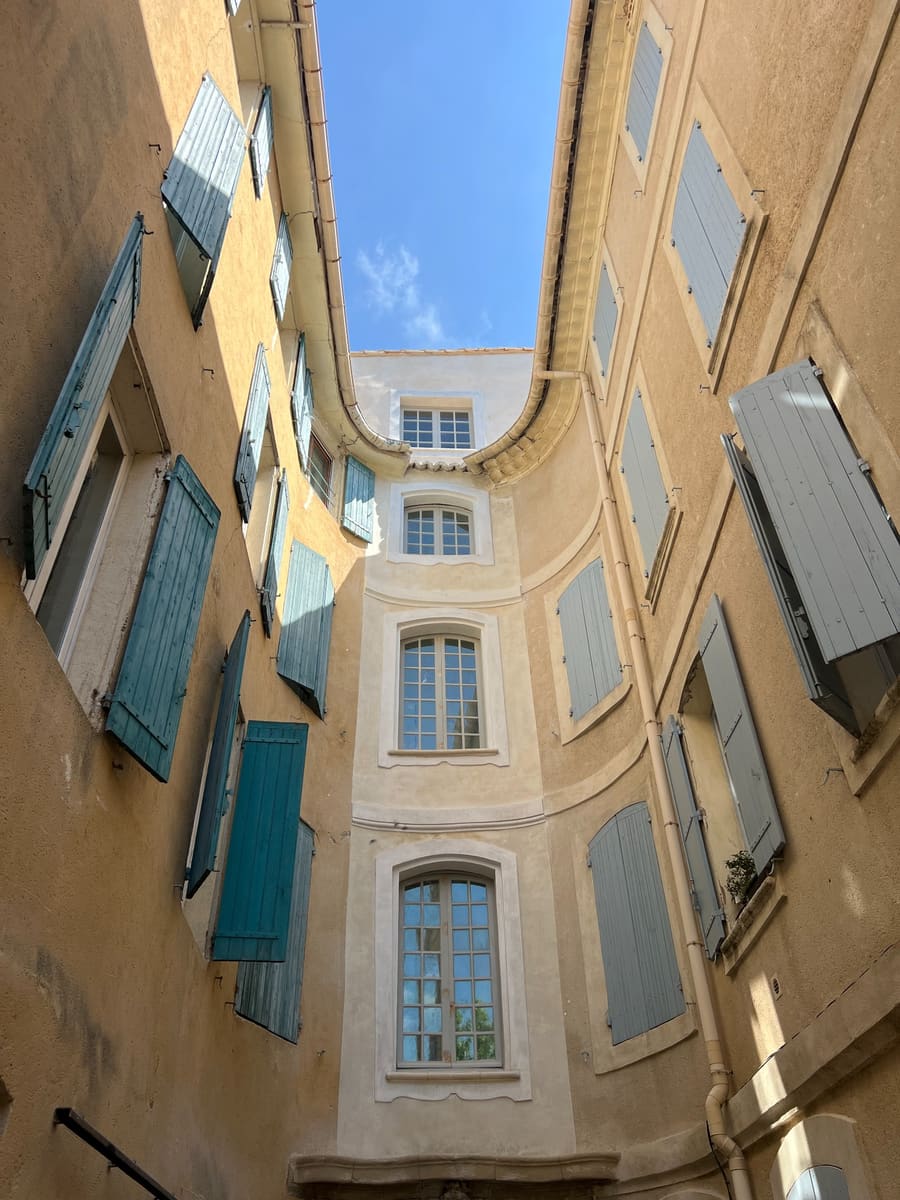
As in the other carrières of the Comtat Venaissin, the lack of space led to a strong densification of housing. Houses sometimes rose over four or five levels, and buildings were organised around narrow courtyards and dead ends.
Two buildings still bear witness today to this specific architecture.
The Beaucaire building, built between 1760 and 1765 for the brothers David-Aaron and Isaac Beaucaire to plans by the architect Esprit-Joseph Brun, is one of the most remarkable examples of the civil architecture of the Jews of the Pope. Its original horseshoe shape directly responds to the constraints imposed on the inhabitants of the carrière: openings had to face inward toward the district. Its monumental staircase, ironwork and gypsery decoration testify to the social level reached by certain Jewish families at the end of the Ancien Régime. Protected as a Historic Monument, it is currently undergoing a major restoration programme.
The Carcassonne building, also dating from the 18th century, is another rare witness to Comtadin Jewish housing and preserves several original architectural elements, notably its elegant ironwork.
What makes the carrière of L’Isle-sur-la-Sorgue particularly remarkable today is that it continues to provide researchers with new information. Where other Jewish quarters have disappeared without leaving traces, historical and archaeological studies here make it possible to gradually reconstruct the organisation of the district, its evolution and the living conditions of its inhabitants.
The Jewish cemetery
Located in the Bagnoles district, outside the old town centre, the Jewish cemetery of L’Isle-sur-la-Sorgue is attested from the 15th century. It remained in use until the early 20th century and is today one of the rare still-visible witnesses to the continuity of Jewish presence in the town.
As in the other cemeteries of the Jews of the Pope, the oldest graves are particularly simple. Inscriptions are often limited to a few religious or family indications, which makes the identification of some burials difficult today.
Since 2013, a major research programme has enabled the clearing of the site, the recording of preserved inscriptions, the analysis of funerary structures and the three-dimensional digitisation of the entire cemetery. This research has considerably enriched knowledge of the Jewish families of L’Isle-sur-la-Sorgue and their funerary practices. Now protected as a Historic Monument, the cemetery is the subject of restoration and interpretation projects intended to make this exceptional place of memory better known.
Visiting today
The former carrière can be discovered around the present-day Place de la Juiverie, where the organisation of the district still makes it possible to understand the constraints and ways of life of the Jewish communities of the Comtat. Visitors can also observe the Beaucaire building, an exceptional testimony to the civil architecture of the Jews of the Pope, as well as the areas where the former synagogue stood, now at the heart of archaeological research carried out by the town.
Outside the old town centre, the Jewish cemetery of Les Bagnoles is one of the most moving testimonies to this centuries-old history. Research, restoration and mediation projects carried out over several years are helping to restore visibility to this long-overlooked heritage.
L’Isle-sur-la-Sorgue thus offers a distinctive approach to the Route of the Jews of the Pope: that of a town where archaeology, archives and heritage studies are bringing a largely vanished past back into view.
Coming soon
The creation of the Espace Beaucaire, a future interpretation centre devoted to the history of the Jews of the Pope in L’Isle-sur-la-Sorgue and the Comtat Venaissin, will present to the public the archaeological and historical discoveries made in recent years. Winner of the 2025 National Jewish Heritage Programme of the Fondation du patrimoine and the Edmond J. Safra Foundation, this project illustrates the national recognition of the work undertaken by the town to make known and transmit a long-overlooked heritage.
Pernes-les-Fontaines
Historical introduction
Pernes-les-Fontaines holds a particular place in the history of the Jews of the Pope. The presence of a Jewish community is attested there in the Middle Ages, before Jewish residence was gradually restricted to the four communities of Avignon, Carpentras, Cavaillon and L’Isle-sur-la-Sorgue.
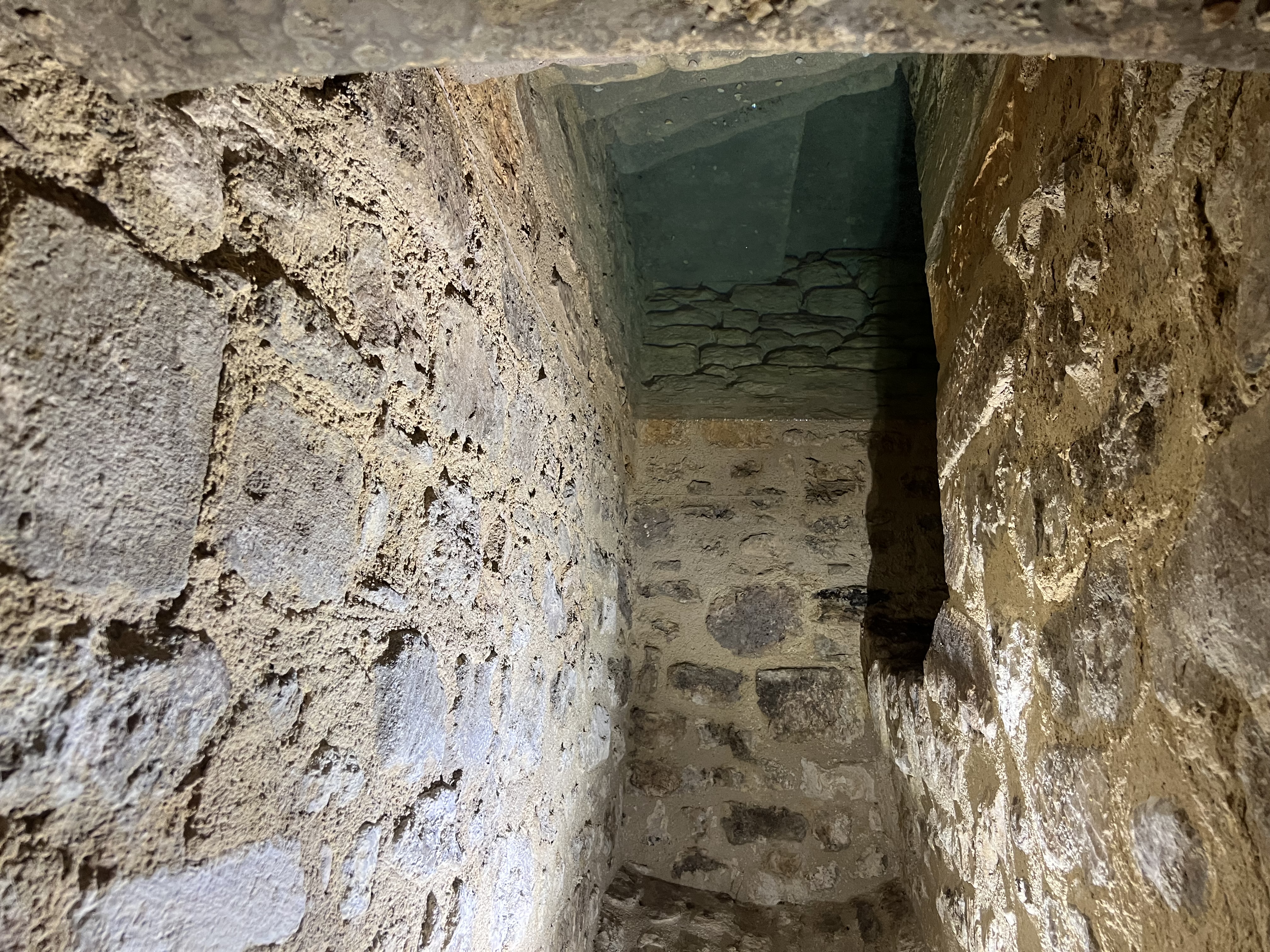
Although the major communal monuments have disappeared, Pernes preserves an exceptional testimony to this presence: several Jewish ritual baths, or mikvaot, located in the area of the former Jewish quarter. These remains make the town an essential stage for understanding the medieval origins of Jewish presence in the Comtat Venaissin.
Pernes-les-Fontaines and the Jews of the Pope
The Jewish community of Pernes is attested in the Middle Ages, within the context of the Comtat Venaissin under papal authority. As in the other towns of the Comtat, Jewish families lived under the protection of the popes, but within an increasingly restrictive legal framework.
They were gradually grouped in a specific district, the Jewish quarter, around today’s Place de la Juiverie. After the papal decisions of the 17th century, Pernes ceased to be among the authorised places of residence for the Jews of the Pope, in favour of the four communities of Avignon, Carpentras, Cavaillon and L’Isle-sur-la-Sorgue.
The synagogue
Archives attest to the existence of a synagogue in Pernes in the Middle Ages, but the building has not been preserved. Its exact location cannot be reconstructed with certainty.
By contrast, the mikvaot preserved in the area of the former Jewish quarter are material remains directly linked to the community’s religious life. They make it possible to evoke the ritual practices and daily organisation of a medieval Jewish community in the Comtat in concrete terms.
The carrière
The former Jewish quarter was located around today’s Place de la Juiverie. The buildings have been extensively transformed, but the place name and archaeological discoveries recall the existence of this communal district.
The distinctive character of Pernes lies less in the preservation of a monumental ensemble than in the presence of remarkably documented ritual baths. The earliest known is that of the Hôtel de Cheylus, located in the area of the Place de la Juiverie. Listed as a Historic Monument, it consists of a staircase descending toward a basin supplied by the groundwater table.
Archaeological research carried out between 2016 and 2018 on the Place de la Juiverie identified a second mikveh, followed by the remains of a third ritual bath. These discoveries are major, as they reveal the presence of several ritual baths within the same area of the former Jewish quarter.
The Jewish cemetery
The existence of a Jewish cemetery in Pernes is mentioned in early sources, but no visible remains make it possible today to propose a certain location.
For this reason, it should be mentioned with caution: it bears witness to the former organisation of the community, without constituting today an identifiable heritage site for visitors.
Visiting today
A visit to Pernes-les-Fontaines reveals a more discreet but essential aspect of the history of the Jews of the Pope. Around the Place de la Juiverie, the mikvaot are the main tangible remains of this medieval presence.
This stage complements the other towns on the Route of the Jews of the Pope: while Carpentras and Cavaillon preserve remarkable synagogues, Pernes offers an approach to the medieval origins of Jewish presence in the Comtat and to the ritual practices connected with daily life.