
Architectural and cultural heritage
Carrières, synagogues, cemeteries, rituals, literature and language
In the Comtat and Avignon, the word “carrière” comes from the Provençal carriero, meaning street. It refers to the closed Jewish quarter where Jews were required to live.
Unlike a neighbourhood simply inhabited by Jews, the carrière gradually became a legally imposed space, closed by doors or chains, with a ban on leaving it at night and during certain Christian festivals.
The carrière was at once a compulsory place of residence, a quarter closed at night, a space of religious and communal life, an economic space and a very dense urban fabric.
Impact on the lives of the Jews of the Pope
The carrière created a paradoxical situation: Jews were tolerated and protected in the papal states while being expelled from many neighbouring territories, but this tolerance came with a regime of control, assignment and segregation. After 1624, residence was limited to only four towns.
Main consequences
- overcrowding in restricted spaces;
- building upwards;
- problems of hygiene and overcrowding;
- limits on authorised activities;
- dependence on authorisations from papal or municipal authorities;
- but also the preservation of strong communal autonomy: worship, internal regulations, management of facilities and mutual aid.
In L’Isle, the sources show that some of the wealthier Jews, enriched through horse trading and silk, sought to acquire houses on the edge of the carrière or to move discreetly away from it.
Architectural details
Carrières can be recognised by their narrow, often single streets, doors or chains at their ends, tall interlocking houses, vaulted passages and a synagogue integrated into the urban fabric.
In Cavaillon, Rue Hébraïque passes beneath the synagogue, forming a covered public passage. In L’Isle, the synagogue rebuilt in the 18th century was about 12 metres high.
The Beaucaire building, constructed between 1760 and 1765 in the carrière of L’Isle-sur-la-Sorgue, is one of the major examples of the civil architecture of the Jews of the Pope.
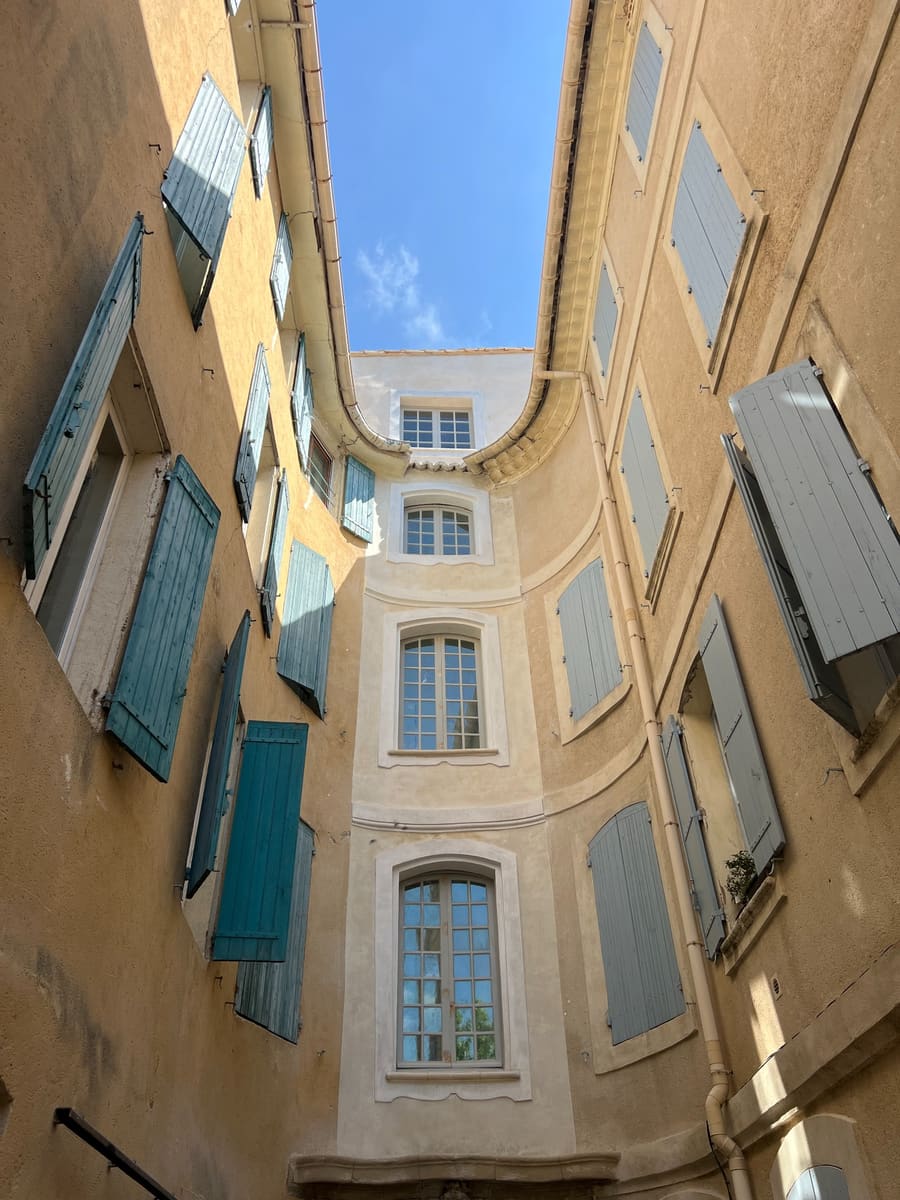
The synagogues of the Jews of the Pope constitute an exceptional heritage, bearing witness to a unique history in Western Europe. Built at the heart of the carrières, the Jewish quarters of the Comtat Venaissin, they reflect both the constraints imposed on their inhabitants and the richness of the religious and communal life that developed there over more than five centuries.
From the outside, these buildings are remarkably discreet. Integrated into the urban fabric of the carrières, their façades blend into the surrounding houses and reveal little of the richness within. This contrast between a sober exterior and a richly decorated interior is one of their most striking characteristics.
Their decoration is notable for its close resemblance to eighteenth-century Provençal churches. Columns, faux marble, carved woodwork, gilding, wrought iron and stucco decorations illustrate the skill of local craftsmen, who also worked on Christian religious buildings. They adapted the artistic vocabulary of their time to the requirements of Jewish worship, creating an original Judeo-Comtadin style where Jewish traditions meet Provençal Baroque art.
The synagogues of the Jews of the Pope were not merely places of prayer. Their vertical organisation brought together, within a single building, all the spaces essential to communal life: separate prayer rooms for men and women, ritual baths (mikvaot), ovens used for baking both daily bread and the unleavened bread of Passover, as well as rooms dedicated to study, meetings and community administration. This concentration of functions was directly linked to life within the carrières, where space was limited and the community was organised around its synagogue.
The synagogues of Carpentras and Cavaillon, the two oldest still preserved, perfectly illustrate these characteristics. Today they rank among the finest surviving examples of Judeo-Comtadin heritage and, more broadly, among the best-preserved historic synagogue complexes in Europe.
The Jewish cemeteries of the Comtat Venaissin and Avignon are today among the major testimonies to the centuries-long presence of the Jews of the Pope in these former French papal territories.
In Jewish tradition, the existence of a burial place specific to the community is essential: the cemetery is a sacred space where graves are normally never disturbed.
In medieval southern France, the earliest documented traces of Jewish cemeteries appear as early as the 13th century. The cemetery of Cavaillon is attested in 1217, even before the lasting establishment of the popes in Avignon. After the attachment of the Comtat Venaissin to the papacy in 1274 and the installation of the papal court in Avignon in the 14th century, Jewish communities gradually obtained burial grounds recognised and protected by seigneurial, episcopal or municipal grants.
The cemeteries of the Jews of the Pope have several remarkable features:
- they are almost always located outside the ramparts or away from residential areas, in keeping with medieval practice;
- the oldest graves are often very simple, sometimes without a visible stele;
- in the papal Comtat, the authorities at certain times imposed restrictions on funerary monuments: in Carpentras, between 1625 and the Revolution, graves could not bear monumental tombstones;
- epitaphs frequently combine Hebrew and French, sometimes Provençal;
- several cemeteries retain specific ritual features: ablution fountains, purification spaces, funerary repositories or possible genizot;
- unlike many vanished medieval Jewish cemeteries in Europe, those of Avignon, Carpentras and L’Isle-sur-la-Sorgue have maintained a continuity of memory through the 19th and 20th centuries and down to the present day.
Carpentras — the most imposing Jewish cemetery in the region
History: a first Jewish cemetery existed near the Porte d’Orange; it disappeared after the expulsion ordered by John XXII around 1320. The current cemetery was granted on 2 January 1344 by Bishop Hugues, in return for an annual fee.
Distinctive features: around 900 visible tombs, mostly dating from after the Revolution, since from 1625 to the Revolution the papal authorities forbade the erection of steles. The site covers 3.3 hectares at the foot of the aqueduct.
Contemporary memory: it remains marked by the desecration of May 1990, which had national repercussions.
Status: property of a religious association; listed as a historic monument since 2007.
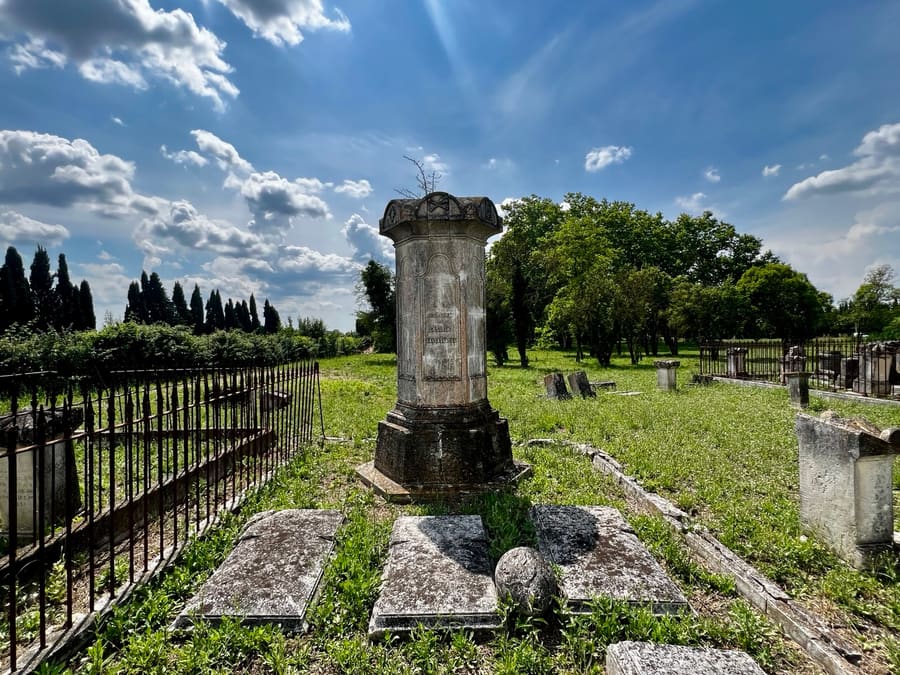
L’Isle-sur-la-Sorgue — a preserved former Jewish cemetery
History: first mentioned, depending on the sources, between 1465 and 1476; enlarged in 1736; last burial in 1939.
People / families buried: around 40 graves, with family enclosures for the Créange, Crémieux, Carcassonne and Abram families. Israël Abram, the first mayor of L’Isle under the Third Republic in 1870, is buried there with his father David Samuel Abram.
Distinctive features: a cemetery set apart in the plain, in the Bagnoles district; few Hebrew signs are visible today; no known ritual facilities such as a water point, repository or genizah.
Status: municipal property; the former Jewish cemetery has been listed in its entirety as a historic monument since 2008, including the gate, graves, monuments, ground and subsoil.
Avignon — former Jewish cemetery of Saint-Roch / Champfleury
History: the Champfleury cemetery was acquired by the Jewish community on 29 October 1792. It succeeded two vanished cemeteries: La Pignotte, c. 1235–1710, and Saint-Symphorien, near the Porte de la Ligne, c. 1700–1791.
Distinctive features: around 600 burials, two mausoleums and about fifty vaults over roughly 2,000 m²; short epitaphs in Hebrew and French; the presence of a former ablution fountain and an element interpreted as a genizah or former repository.
Status: historic private cemetery.
These cemeteries are no longer active.
Main sources
- General Inventory of Cultural Heritage – Région Sud
- Base Mérimée – Ministry of Culture
- Jewish Religious Association of Carpentras (ACJP)
- Heritage Department of L’Isle-sur-la-Sorgue
- JGuide Europe – Jewish Heritage Guide
- Department of Vaucluse – Jewish heritage of the Comtat
- Danièle Iancu-Agou, Jews and Neophytes in Provence
- Carol Iancu, works on the Jews of the Pope and the Comtadin communities
- Armand Lunel, Jews of Languedoc, Provence and the French States of the Pope
- Bernard Blumenkranz, works on medieval Jewish communities in southern France
Liturgical rituals
The Jewish communities of the Comtat Venaissin and Avignon developed their own liturgical rite, known as the Comtadin rite. It was practised in the four main communities: Carpentras, Avignon, Cavaillon and L’Isle-sur-la-Sorgue.
This rite shows links with Sephardic traditions, while retaining local features developed within the closed framework of the carrières, the Jewish quarters of the Comtat.
Until the 18th century, rituals circulated mainly in manuscript form. In 1767, Avignon saw the publication of the Seder Hatamid, a prayer book for the Comtadin communities, edited by Élie Crémieux at the request of Mardochée Crémieux.
The rituals included in particular:
- piyyutim (hymns),
- tehinot (supplications),
- nichmatim (elegies),
- tefilot (specific prayers).
Liturgical chants were transmitted orally. In 1885, Jules and Mardochée Crémieu published a collection of these chants under the title Hebrew Chants According to the Rite of the Jewish Communities of the Former Comtat Venaissin.
After the French Revolution and the dispersal of the communities, the Comtadin rite continued to be practised in several cities in southern France, notably Aix-en-Provence, Marseille, Montpellier and Nîmes.
The Jews of the Pope developed a culture of their own, marked in particular by the use of Judeo-Provençal, also called Hebraico-Comtadin or “Shuadit” (from the Hebrew word yehudit). This language combined vernacular Provençal, Hebrew and terms specific to local Jewish communities. It was essentially oral. Literary works, by contrast, were generally written in Provençal.
Judeo-Provençal disappeared in the 20th century. Among its last speakers were Blanche Mossé, custodian of the Carpentras synagogue, and, according to other sources, Armand Lunel.
One work from the period that perfectly illustrates the cross-community creativity of the Jews of the Pope is La Reine Esther, composed in the 17th century by Rabbi Mardochée Astruc of L’Isle-sur-la-Sorgue, then revised in the 18th century by Jacob de Lunel, rabbi of Carpentras, and printed in that town in 1774. It later inspired the writer Armand Lunel when he wrote his opéra-bouffe Esther de Carpentras, with music by Darius Milhaud, himself from one of the oldest Jewish families in Provence, originating in the Comtat Venaissin.
Another form of literary production consisted of obros or piyyutim, poems alternating one verse in Hebrew and one in Provençal. These texts were composed for events such as weddings, circumcisions or certain religious festivals, notably Purim, and were then sung.
Hebrew remained the language of religious texts, community regulations, registers and scholarly works. Several authors and scholars are mentioned in the sources, including Joseph ben Abraham, Mordekhaï ben Jacob of Carpentras and the Crémieux brothers.